Marathon Pacing Strategy: How to Run the Second Half
Why 87% of runners slow down, what actually happens at 30km, and how to pick a pace you can hold to the finish
Colin Norris
11 MIN
Across an analysis of more than 876,000 marathon finishes, 87% were positive splits. The second half was slower than the first. The average slowdown was 8%.
Eight percent doesn't sound dramatic until you translate it. For a runner targeting 3:30, an 8% fade over the back half is about eight and a half minutes. That is the difference between the time you trained for and the time you tell people about with a caveat attached.
Almost none of those runners set out to slow down. They set out to bank time, and the two things turn out to be the same decision.
Even, positive, or negative: what the research actually says
Three pacing patterns, and the evidence is less romantic than the internet suggests.
Positive split. Second half slower. This is what 87% of runners do, and for most of them it isn't a strategy, it's an outcome.
Even split. Both halves within about 1%. This is what the research points to for recreational runners chasing a time, and what around 70% of sub-three-hour finishers achieve. The causation runs both ways: even pacing produces better times, and being fitter makes it easier.
Negative split. Second half faster, and it carries a mystique it hasn't entirely earned. Most record-breaking elite performances follow an even or slightly negative profile, executed as tiny differentials across the whole second half rather than heroic surges from 35km. The logic is simple: start conservatively and you burn carbohydrate more slowly, produce less of the acidity that makes muscles feel heavy, and carry less heat into the closing stages.
But the version worth chasing is slight. For a 3:30 runner that's 5:00/km out and 4:57/km back. Three seconds per kilometre. Not a late attack, just discipline in the first hour leaving you something at 35km.
The practical conclusion: aim for even, accept slightly positive, and treat a negative split as a bonus that emerges from good execution rather than a target you chase from the gun.
What actually happens at 30km
The wall is not a mystery and it is not a failure of character. It's a fuelling calculation.
A well-trained runner stores roughly 500g of glycogen across muscle and liver, about 2,000 kilocalories. Marathon running costs roughly one kilocalorie per kilogram per kilometre, so a 70kg runner spends around 2,950 kcal over the distance. At marathon effort perhaps 80% comes from carbohydrate: about 2,360 kcal of glycogen against 2,000 available.
Put plainly: you are trying to pay for a 3,000 kcal race mostly out of a 2,000 kcal carbohydrate wallet. Something has to give.
That deficit arrives around 36km for a 70kg runner and around 31km for an 80kg runner. It's why the wall turns up at roughly the same point, race after race.

This is also why fuelling and pacing are one decision, not two. Taking on 60-90g of carbohydrate per hour, as we set out in our race day nutrition guide, extends the runway. It does not buy permission to start faster.
What happens when the tank runs low is a forced metabolic switch. Fat stores are effectively unlimited, but fat can't be converted to energy at the rate carbohydrate can. Research tracking runners through a marathon documents exactly this: after 30km, speed drops, respiratory exchange ratio falls, and the body shifts toward fat. Your engine doesn't stop, it downshifts, and you cannot override the gearbox. Starting slower and fuelling well doesn't change the gearbox, but it delays the downshift.
There's a second mechanism alongside it, and it's the one runners underestimate. Central fatigue is your brain reducing the drive it sends to your muscles, based on its in-the-moment read of how much trouble you're in. Your brain is essentially a worried parent with a hand on the dimmer switch. The same research found runners finishing with reduced brain activity and perceived exertion above 15 on the Borg scale. Some of what you feel at 35km is your legs. Some is a decision made above your neck.
Both are shaped by how you ran the first half. Go out fast and you burn carbohydrate earlier, reach the switch sooner, and give your brain more reason to intervene.
Why banking time doesn't work
Here's what the trade returns. Ten seconds per kilometre faster than goal pace for the first half banks 3.5 minutes. Then:
A mild fade of 15 sec/km over the final 12km costs 3.0 minutes. Net gain: 30 seconds.
A moderate fade of 25 sec/km costs 5.0 minutes. Net loss: 1.5 minutes.
A genuine blow-up at 45 sec/km costs 9.0 minutes. Net loss: 5.5 minutes.
Walking breaks at 75 sec/km costs 15 minutes. Net loss: 11.5 minutes.
The upside is capped at about thirty seconds. The downside is not capped at all. You are accepting an unlimited liability to win, at best, half a minute.
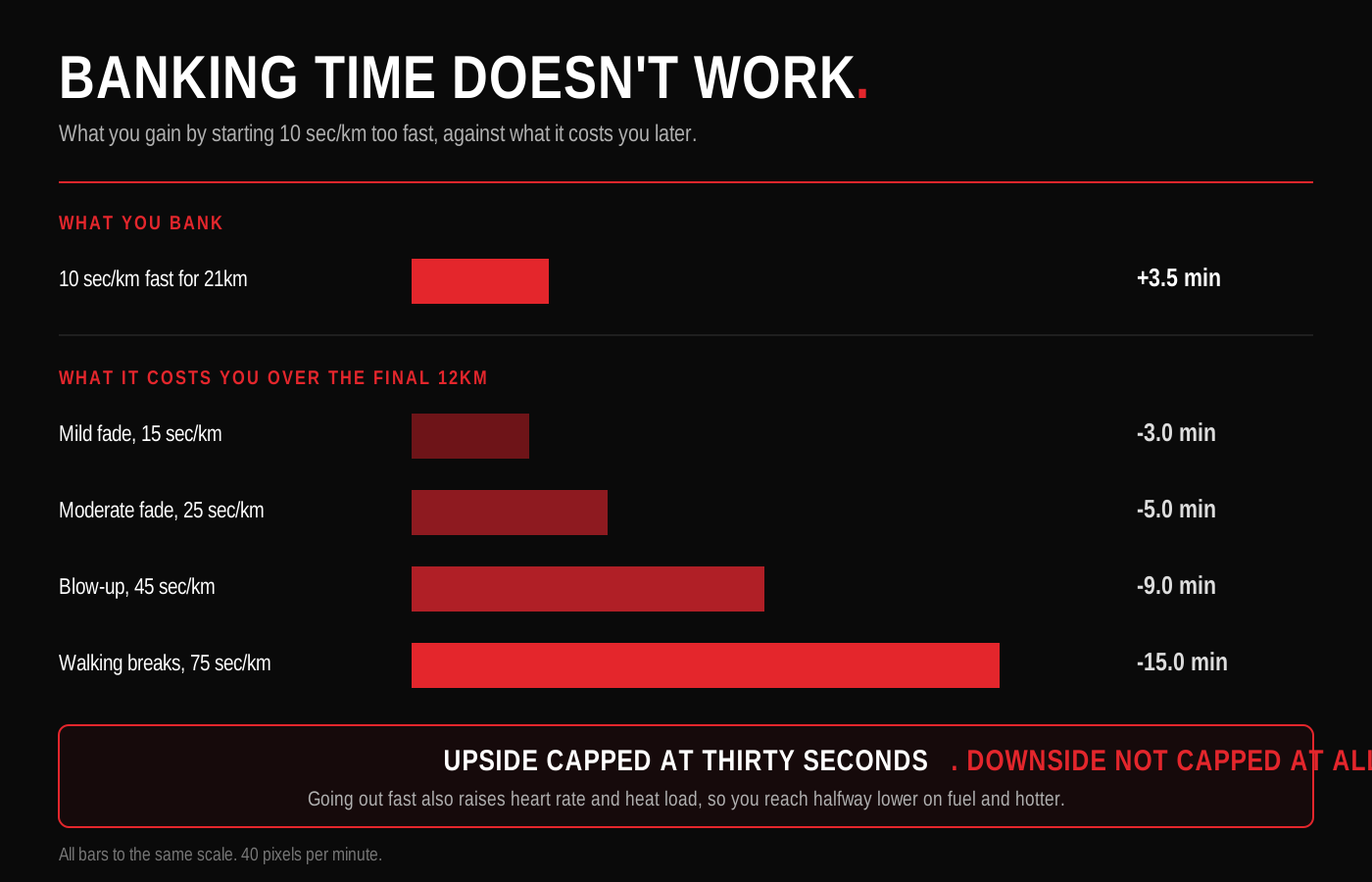
The numbers understate it. Those extra 10 seconds per kilometre also raise your heart rate, generate more heat, and accelerate cardiac drift, so you reach the second half both lower on fuel and hotter than you should be. The clock is only one thing you overspend.
On undulating courses, run to effort rather than pace and let the splits fall where they fall. What you should not do is bank time on early downhills. Downhill running is eccentrically expensive, and the muscle damage bill arrives later, usually right where you wanted that banked time. We explain why, and how to prepare for it, in our guide to downhill running training.
How to pick a realistic target
Most bad marathons are decided weeks before the start, at the moment someone picks a number they'd like to be true.
Start with a recent race, not a hope. A half marathon from the last six weeks is the best predictor. Double it, then add 4 to 6%. Add 4% if volume has been high and long runs have gone well, 6% if mileage was modest or the half was all-out.
A percentage matters here, because the same fixed margin shouldn't apply to a 1:25 half and a 2:10 half.
Worked example. A 1:40 half, decent long runs, reasonable volume. Doubled is 3:20. Add 5% and your target is 3:30.
Worked example. A 1:37 half, strong block, good mileage. Doubled is 3:14. Add 4 to 5% and your target is 3:22 to 3:24.
This is a tool for well-trained recreational runners, not for a 1:15 half marathoner, whose conversion is a different conversation.
Cross-check against your long runs. Goal pace should feel comfortably sustainable through the middle of a 30km long run. Not hard. Comfortable. If you've never held it for 20km while fresh, holding it for 42km on tired legs is optimistic.
Ask how much the plan had to move. The useful question isn't whether you completed every session, it's how often the plan needed rewriting around you. A block that ran mostly as intended supports the target you set in week one. A block where sessions were repeatedly shifted or dropped tells you the honest number is slower, which is the point of managing load properly rather than measuring intentions. Worth talking through with your Zepho coach, which sets pace from your actual races and sessions rather than a generic formula.
Then account for the taper you actually did. A good taper is worth around 2%, which is roughly 3.5 minutes on a 3:00 target and 5.5 minutes on a 4:30. A taper you cut short because you felt sluggish and panicked is worth considerably less.
The pace bands
Four common targets. Every figure uses the full 42.195km, not a rounded 42km, which is where a lot of published pace charts quietly lose you 30 seconds.

The first 10km window matters most and gets ignored most. It's deliberately 5 to 10 seconds per kilometre slower than goal pace. You'll feel like you're jogging. You'll be overtaken by people you'll pass again at 32km. That's the plan working, not failing.
If you drift outside the window by five or ten seconds, don't correct sharply. Steer gently back over the next kilometre. A surge to fix a slow split costs more than the split did.
If you want a structure rather than a single number, run it in thirds.

"Hold effort" means you stop negotiating with pace and maintain the effort you've been running, accepting whatever speed comes with it. Some days that's a negative split. Most days it's keeping the fade small.
Adjusting for the conditions
Your goal pace assumed a temperate morning. If race day is warm, the number on your wrist is fiction, and holding it costs more than adjusting.
Ely and colleagues' analysis of 1.8 million finishing times found performance degrades roughly 1 to 2% per degree Celsius above about 15°C. Applied to our targets:
Temp. | 3:00 becomes | 3:30 becomes | 4:00 becomes | 4:30 becomes |
|---|---|---|---|---|
18°C | 3:05 to 3:11 | 3:36 to 3:43 | 4:07 to 4:14 | 4:38 to 4:46 |
21°C | 3:11 to 3:22 | 3:43 to 3:55 | 4:14 to 4:29 | 4:46 to 5:02 |
24°C | 3:16 to 3:32 | 3:49 to 4:08 | 4:22 to 4:43 | 4:54 to 5:19 |
Take the faster end if you're well heat-acclimated and humidity is low, the slower end if it's humid, exposed, or you've trained through a cold winter. The physiology is in running in the heat.
Two rules for hot races. First, do not try to earn back time during the cool first 10km. A pleasant 7am tells you nothing about 11am, and the fuel you spend early is what you'll want when the heat climbs.
Second, use heart rate as an early warning. If you normally race around 150 to 155 bpm and you're already there in the first 5 to 10km at goal pace, goal pace is no longer the right pace today. Adjust then, not at 30km.
The decision has to be made before the gun. Runners who reset their target in the start pen finish. Runners who decide to see how it goes usually don't get to choose.
The psychology of the first hour
Everything above is numbers. This part is the hard bit.
At 5km you feel superb. Tapered, adrenalised, surrounded by people, running a pace that feels absurdly easy because it is, at that moment, absurdly easy. Every instinct says the plan is too conservative.
That feeling is not information. It's the predictable result of being fresh and excited, and it will be gone by 28km whether or not you act on it.
Expect to be overtaken. In the first 10km a steady stream of runners will pass you, many of whom have made a mistake they don't know about yet. If a pack goes by 5 to 10 seconds per kilometre quicker than your window, let it go. Your group is the one you find at 20 to 25km, not at 5km.
Set your watch to lap pace, not instantaneous pace. Instant GPS pace is noisy and encourages micro-corrections that add up to going too hard. Set 1km or 1 mile auto-laps and read the lap average. Practise this in long runs, so by race day you've connected a pace to an effort to a heart rate to a feeling. That calibration is what you're actually racing with.
Decide your non-negotiables in advance. One rule is enough: you do not run faster than the first-10km window before 10km, regardless of how good you feel. Not for a downhill, not to stay with a group, not because your watch beeped slow under a bridge.
Holding that takes nerve. You're choosing to trust a decision you made calmly weeks ago over a feeling you're having right now, while people stream past. That's genuinely difficult, and it's also a critical skill. One rule, held for forty minutes, protects the other three hours.
Key Takeaways
87% of marathon finishes are positive splits, with an average second-half slowdown of 8%. For a 3:30 runner that's about eight and a half minutes.
Aim for even splits. A slight negative means around 3 seconds per kilometre quicker in the second half, not a late surge, and it emerges from restraint rather than from chasing it.
The wall is a fuel problem, not weakness. You're paying for a roughly 3,000 kcal race out of a 2,000 kcal carbohydrate wallet, which runs out around 31 to 36km depending on your size.
Banking time is a bad trade. Ten seconds per kilometre too fast gains 3.5 minutes and risks losing five to eleven, while raising heart rate and heat load.
Set your target by doubling a recent half marathon and adding 4 to 6%. A 1:40 half plus 5% gives 3:30. This is a tool for well-trained recreational runners, not for elites.
Run the first 10km 5 to 10 seconds per kilometre slower than goal pace. If the first 5 to 10km feel slightly boring, you're probably doing it right.
Adjust for heat before the start, not at 25km. Roughly 1 to 2% slower per degree above 15°C, and treat an early-race heart rate at your normal marathon number as a warning.
You cannot win a marathon in the first 10km, but you can comprehensively lose one. The runners who finish strong are almost never the ones who felt best at 5km. They're the ones who felt slightly bored at 5km and had the discipline to stay that way.
Zepho is adaptive coaching for serious runners. It's live and available now on the App Store.