Downhill Running: Why Descending Costs More Than You Think
Why descending is the silent killer, the surprising effectiveness of downhill running training, and why you shouldn't leave downhill training too late.
Colin Norris
11 MIN
Uphill running announces its cost immediately. Your breath shortens, your heart rate climbs, and you yearn for the crest of the climb.
Downhill running, on the other hand, is more of a silent killer. Your heart rate drops, your pace increases, and there's nothing better than floating down the mountain ticking off the kilometres. Then later your quads seize up, your pace on the flat slows, and worse still you stop dead.
What is difficult to manage, and what downhill running training exists to fix, is the gap between when the damage on the descent is done and, well, when you pay the price for it. The damage happens early, silently, and mostly on the descents you enjoyed. Here we explain what causes this damage, how quickly protection builds, and why descending is where most runners are leaving significant time on the table.
Why does downhill running cause more damage than flat running?
The difference is the direction your muscles are working.
On the flat, your quadriceps mostly shorten as they produce force. Uphill, almost entirely so. Downhill, they do the opposite: they produce force while being lengthened, resisting the knee folding underneath you on every landing. That is an eccentric contraction, and it is the most mechanically destructive thing a muscle routinely does.
Eccentric contractions generate high force across relatively few active fibres, which produces mechanical disruption at the microscopic level and damage to the membranes around it. Blood markers of muscle damage rise, and soreness follows a day or two later.

This is why the two directions feel so different in hindsight. Uphill hurts while you are doing it. Downhill hurts, well, later.
Why the delayed response?
Two things get conflated here and only one of them affects your race.
The famous one is delayed onset muscle soreness, the stairs problem two days after a race or a hard session. It arrives long after the race has been decided.
The one that decides your race is force loss, and it starts immediately. As eccentric damage accumulates, the muscle's capacity to generate force declines. That decline is progressive and it does not wait for soreness. Every descent in the first half draws from a finite account.
In the latter stages of the race, two things happen. Your quads can no longer absorb landing forces well, so descending becomes genuinely difficult rather than free. And running on the flat costs more, because the same muscles that are now compromised were also doing the unglamorous work of stabilising you on every stride.
This is why net-downhill road courses are so often slower than they look. A point-to-point marathon that drops steadily in the opening miles reads as fast on the elevation profile. What it actually does is charge your quads heavily while you are fresh enough not to notice, then present the damage done somewhere in the closing stages.
For trail and ultra runners the equation is the same but often much louder and more catastrophic. Steeper gradients mean higher eccentric loads per step, and a mountain ultra can contain several thousand metres of descent. This is now treated as one of the primary limiters in long trail racing rather than a side effect of it. In a recent opinion paper in Sports Medicine, Nicholas Tiller and Guillaume Millet identified muscle damage as the main obstacle to ultramarathon performance, citing a survey of 824 ultrarunners in which 66% named muscle breakdown as their primary impediment. Not fuelling, not aerobic fitness, not heat. Legs that stopped working.
Scott Johnston, who coached both 2025 UTMB champions and co-wrote Training for the Uphill Athlete, puts it bluntly. "The heart doesn't get tired in these races," he told iRunFar. "What I have seen is that athletes are limited by that fatigue factor out at the muscle."
This shows up even in the most conditioned athletes on earth. Look at the heart rate and pace traces from the back end of a Kilian Jornet hundred-miler and both fall away together in the closing stages. That pairing is the giveaway. Heart rate drops when the muscular system is too fatigued to demand as much blood, so a falling heart rate late in a long race almost always coincides with falling speed rather than with settling down. If it happens to Kilian at 140km (87 miles) of 174km (108 miles), it will happen to the rest of us considerably earlier.

Source activity: https://www.strava.com/activities/7708813205/overview
Where the free speed is hiding
Coach David Roche illustrates this well with his own data on a rolling run near Boulder. Descending a smooth dirt trail at around 17.7km/h (11 mph), his heart rate averaged 128, low Zone 1, an effort he could hold all day. Climbing the same hill at 10.8km/h (6.7 mph), his heart rate was 155, Zone 3.
His summary of the asymmetry: on the uphill he felt like he was barely moving while his aerobic system worked hard, and on the downhill he felt like he was pushing while his aerobic system was, in his words, napping.
The training implication is significant. Running 30 seconds per mile faster uphill might push you from Zone 2 into Zone 4, unsustainable and expensive in glycogen. The same gain downhill might move you from Zone 1 to low Zone 2, and Roche notes that for well-adapted runners it can take 60 to 90 seconds per mile before the effort registers aerobically at all.
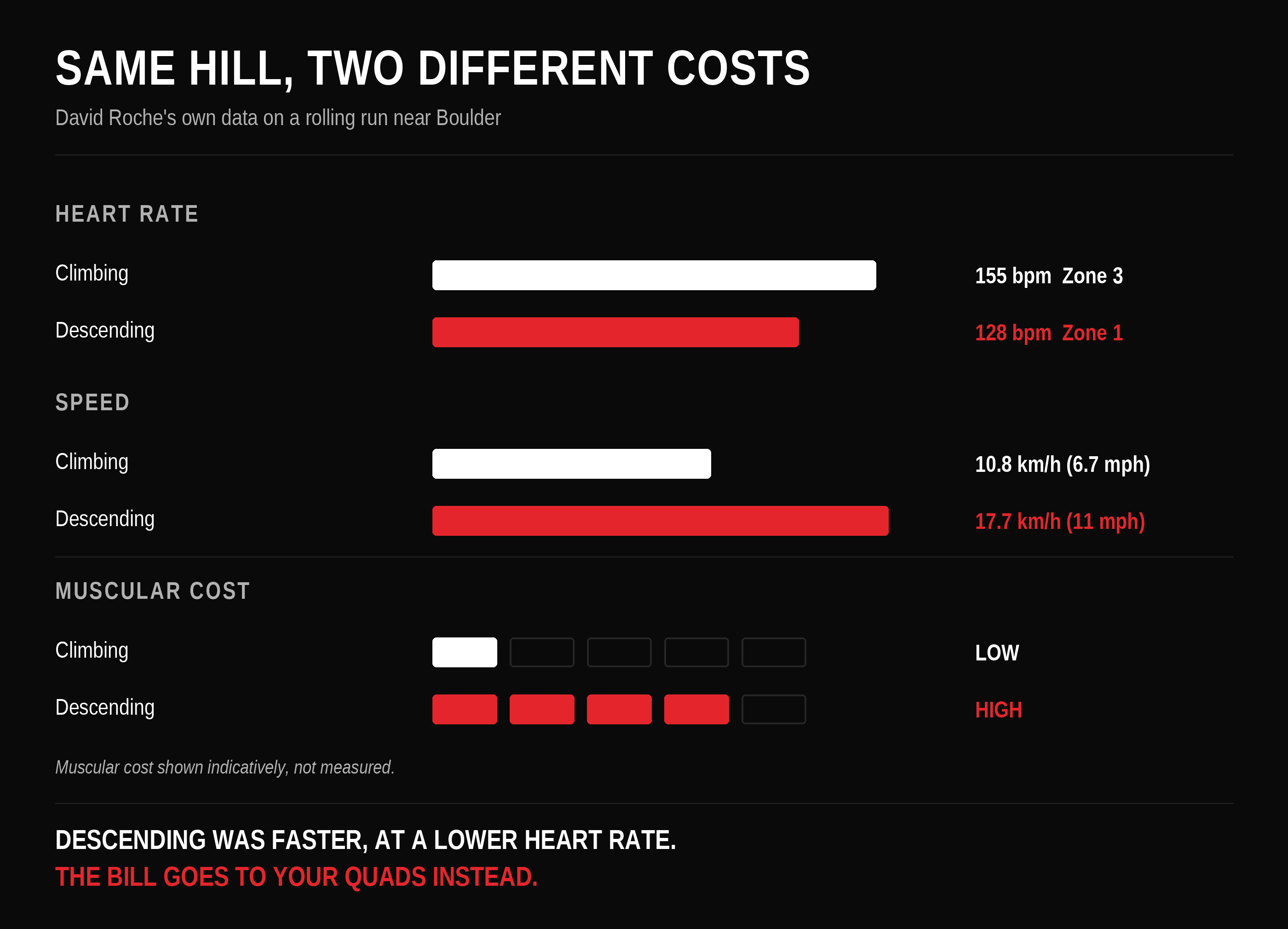
So the downhill is where significant time is available for almost no aerobic cost. The only thing standing between you and it is the biomechanical and neuromuscular capacity to run down a hill fast, and that takes some practice and skill.
The good news is that this capacity adapts surprisingly quickly.
Does downhill training actually protect you?
Yes, and unusually fast.
The protection is called the repeated bout effect, and it is one of the more reliable findings in exercise physiology. Do one bout of damaging eccentric exercise and the next one damages you substantially less. Research on repeated downhill running has found reductions of roughly 42% in soreness and 53% in the blood marker for muscle damage on the second bout.
Roche describes work in which athletes completed two 30-minute downhill treadmill sessions at a 15% gradient a couple of weeks apart, with muscle damage dropping sharply on the second. His point about the speed of it is what matters: almost nothing else in physiology adapts this quickly, particularly not a mechanical quality.

The adaptation involves the nervous system recruiting muscle more effectively, structural remodelling within the muscle, and changes in the connective tissue that transmits force. You do not need to care which. A small number of sessions counts for a lot, and the protection lasts weeks rather than days.
How much downhill running do you actually need?
Less than you would think, and it can be measured in vertical descent or simply in time spent descending.
The clearest protocol comes from David and Megan Roche, who call it "Just Say No To Rhabdo," after rhabdomyolysis, the runaway muscle breakdown that extreme eccentric work can trigger alongside dehydration or heat. The name is doing real work: this block carries a genuine health consideration, not just a soreness one.
Everyone is an individual, but as a general rule of thumb:
Open the window four to six weeks out from your goal race, ideally with some downhill conditioning already behind you.
The dose is total descent, or the time you spend descending. Shorter races need less, in the region of 500m (1,600ft) of quality steep vertical. Most distances are covered by around 1,000m (3,300ft), and a long steep ultra justifies roughly double. If vertical is hard to measure where you run, accumulated minutes of good descending does the same job.
Two or three sessions is usually plenty, separated by at least four days, spread across the weeks leading in.
Leave the last hard session at least 10 days before the race. Well-adapted athletes can push closer, most should not.
Fuel it properly. Take on 90 to 120g of carbohydrate per hour during the session, which appears to reduce exercise-induced muscle damage, aim for around 2g of protein per kilogram of bodyweight (roughly 1g per pound) that day, and hydrate seriously. That last point is kidney protection, not performance.
Two details in there run against instinct.
Speed matters as much as gradient. Vertical descent alone gets you part of the way, but it is descending quickly that drives the neuromuscular side of the adaptation. The cue Roche gives athletes is simply "quick, quick, quick."
The goal of the session is to get sore. That is the stimulus. You are looking to reach the point where a session that once wrecked you no longer produces soreness at all, which is the signal the adaptation has happened.
Not everyone thinks this needs to be a separate block. Cliff Pittman, Coaching Development Director at CTS, argues muscular endurance is handled implicitly by consistent volume over the right terrain. He has a point: if you live somewhere hilly and run there regularly, you are largely doing this already.
The runners who need the protocol are the ones whose training terrain does not match their race terrain. A flat-city marathoner heading to a net-downhill course. A road runner entering their first hilly trail race. Anyone whose long runs are on a canal path and whose goal race is not.
A note on how you introduce it. It is often less risky to keep a stimulus ticking over all year, even at low volume, than to add it suddenly in a block. Sprinkling some downhill running into your week works very well, and it turns the four-to-six-week window into a sharpening exercise rather than a shock. The simplest way to do it is not a separate workout at all. Take the long runs you already do and descend the hills in them with purpose.
What if your race is in three weeks?
Then be careful about what you start.
If you have done no downhill work at all and your race is inside three weeks, introducing it now could be risky: you would arrive with damaged muscle and insufficient time to express the adaptation. If you have some downhill conditioning behind you, one session at around two weeks out, finishing no later than 10 days before the race, can work well.
Either way, the bigger lever this close to a race is the plan. Specifically: do not bank time on the early descents. This is the same argument we make about banking time in our marathon pacing guide, and downhill running is where it costs most, because the early descents are exactly where banking feels free and is most expensive.
How should you actually run downhill?
Technique will not exempt you from eccentric loading, but it can significantly impact how much of it you can handle.
Downhill running invites overstriding, because the instinctive response to gathering speed is to reach the front leg out and brake. A foot landing well ahead of your centre of mass generates a braking force you then have to overcome, a few thousand times over.
Some simple changes can make a huge difference to how you absorb the impact:
Shorten the stride and raise the cadence. Roche makes the argument for this better than the biomechanics textbooks do: careful, heavy footfalls require every step to be perfect, whereas quick, light steps mean you are not punished for the imperfection that is coming anyway. By the time one foot has landed badly you are already on the other one.
Lean with the slope, not against it. Leaning back feels safer but it is mechanically costly, because it forces a heel-first landing with the leg extended.
Land with a soft knee. A slightly flexed knee lets the joint and muscle absorb load progressively. A straight leg transmits it.
Look ahead, not down. Eyes four or five metres (13 to 16 feet) in front lets you choose a line rather than react to one.
Stay loose. Tension turns your ankles into the only shock absorber you have, instead of spreading the work through the whole leg.
The counterintuitive summary is that controlled speed is usually cheaper than braking. Within the limits of the terrain and your own confidence, running a descent costs your quads less than fighting it. The runner picking their way down nervously is often doing more eccentric work than the one moving freely. Although relaxing while running steeply off the side of a mountain is easier said than done.
On genuinely technical terrain, in the dark, or when you are tired enough that foot placement is deteriorating, caution is correct and the extra muscular cost is worth paying.
Pair all of this with eccentric strength work and you get more from both. Slow step-downs, controlled split squats and Romanian deadlifts train the same lengthening-under-load pattern in a more controlled setting, which is part of the argument in our guide to strength training for runners.
One last note for anyone adding this to an already full block: eccentric sessions carry a recovery cost that does not show up in your usual metrics, which is the broader problem we cover in training load management.
Key Takeaways
Downhill running damages muscle because the quadriceps produce force while lengthening. Uphill hurts while you do it, downhill hurts later.
The damage that decides your race is not soreness, it is force loss, and it begins immediately. Every early descent draws from a finite account.
Watch heart rate and pace together late in a long race. When both fall away at once, that is the muscular system failing rather than you settling down. It happens to Kilian Jornet at 140km (87 miles), so it will happen to the rest of us sooner.
In a survey of 824 ultrarunners, 66% named muscle breakdown as their primary limiter. Not fuelling, not fitness. Legs that stopped working.
Descending is where free time lives. The same hill that puts you in Zone 3 going up leaves you in Zone 1 coming down, so running it faster costs almost nothing aerobically once you have the legs and technique for it.
The repeated bout effect is real and quick. One meaningful downhill cuts the damage from the next substantially, with reported reductions of around 42% in soreness and 53% in muscle damage markers.
As a rule of thumb, two or three quality sessions in the four to six weeks before a race covers most of it. Dose by vertical descent or by time spent descending, whichever you can actually measure, and descend quickly rather than just repeatedly. Finish the last hard session at least 10 days out.
Better still, keep a low dose of downhill running ticking over year round. Adding a stimulus suddenly is riskier than maintaining one.
Fuel these sessions hard and hydrate seriously. Rhabdomyolysis risk is real when extreme eccentric work meets dehydration or heat.
If you are within three weeks of your race with no downhill conditioning behind you, now is probably not the time to start. Take those opening descents conservatively on race day instead.
Most runners treat descending as the reward for climbing. It is the part of the course that quietly decides how the closing stages go, and one of very few limiters you can meaningfully train for in under a month.
Zepho is adaptive coaching for serious runners. It's live and available now on the App Store.