Race Day Nutrition from 5km to Marathon: What to Eat Before, During, and After Your Race
From carb loading to finish line, the fuelling plan that keeps you running strong when it matters most
Colin Norris
13 MIN
You've done the training. You've nailed the taper. Your legs feel fresh, your mind is ready, and your race plan is dialled in. Then somewhere around mile 20 the wheels come off, or you spend the second half hunting for portaloos, and all that work goes sideways because you got the fuelling wrong.
It happens more often than it should, and it's almost entirely preventable. Race day nutrition isn't complicated, but it is individual, and it needs to be practised. The difference between getting it right and getting it wrong is often the difference between a PB and being hunched over, looking at the floor!
This guide covers everything from the 48 hours before your race to the finish line, whether you're doing a 5km or a marathon. Every recommendation is evidence-based, practically tested, and written for actual humans rather than lab subjects.
One thing to say up front: treat everything here as a reference point rather than a prescription. The numbers come from good research, but research describes averages, and you are not an average. The runners who fuel well are the ones who take these ranges, test them in training, and then adjust based on what their body actually tells them on the day.
Carb Loading for a Marathon: The 48-Hour Protocol
Carbohydrate loading, or glycogen supercompensation if you want to sound clever at the start line, is one of the most well-supported strategies in endurance nutrition. Your muscles normally store roughly 2-2.5 grams of glycogen per 100 grams of muscle. With a proper loading protocol, you can push that to around 4 grams per 100 grams. You're essentially fitting a bigger fuel tank.
The good news: the old seven-day depletion protocol from the 1960s is dead and buried. You don't need to spend three days eating nothing but chicken before switching to pasta. A 2025 systematic review by Solem, Clauss, and Jensen in Frontiers in Physiology confirmed that 36-48 hours of high carbohydrate intake combined with your training taper achieves the same glycogen levels as the old approach. If you're already tapering properly, you're halfway there.
Here's what it looks like in practice.
Two days before the race: Aim for 8-10 grams of carbohydrate per kilogram of body weight. For a 70kg runner, that's 560-700 grams, though treat the lower end as the realistic target for most people. Now, nobody actually weighs their food, so let's translate that into real life. A medium bowl of cooked pasta (roughly 300g, about two cups) gives you 75-90g. A bagel is around 50g. A large jacket potato is about 60g. A banana is 25g. A bowl of porridge with honey lands around 70g. Add a few glasses of fruit juice and some rice cakes with jam between meals and you'll get there without much drama.
For context: one gram of carbohydrate is four calories. So 600g of carbs is roughly 2,400 calories from carbohydrate alone, which is why this feels like a lot of eating. It is a lot of eating, especially since your training volume has dropped.
The day before the race: Push to 10-12 grams per kilogram, so 700-840 grams for our 70kg runner. Eat frequently, prioritise simple carbs (for example: white rice, white bread, pasta, potatoes), and don't worry about eating "clean." This is about maximising glycogen, not winning a nutrition award.
If those numbers look high to you, you are not alone! For some higher mileage runners this could look like quite a normal training day intake of carbohydrate and for lower mileage runners it can seem like quite an uplift, and it is!
Please note, the carbs do not all have to come from 'real food.' A couple of 80g (320kcal) carb/energy drinks mixed with water can help you top up without feeling like you are force-feeding.
It is also important to note that with every gram of glycogen you store, it binds roughly three grams of water, so a full load can put 1-2kg on the scale and leave you feeling heavy and sluggish on the start line. So, whilst the studies largely support maximal glycogen storage you need to have a feel for it and stop when you feel full. This takes practice and experience so use the ranges as a guide not absolute.
One important detail on the night before: eat dinner early. If you're racing at 7am, aim to eat by 7pm. That twelve-hour gap gives your body time to digest properly and, to put it delicately, to finish processing everything before you're standing in a start pen wondering where the nearest toilet is.
What to avoid in those 48 hours: anything new or untested, excessive fat (it slows gastric emptying), spicy food, and alcohol. It's also worth following a low-residue diet, which means limiting whole-grain breads and cereals, nuts, seeds, raw or dried fruits, and large volumes of vegetables. "Residue" is the undigested food, mostly fibre, that ends up as stool. The goal is fewer and smaller bowel movements in the days before your race, which reduces bloating, gas, cramping, and the mid-race emergencies nobody wants to talk about or experience.
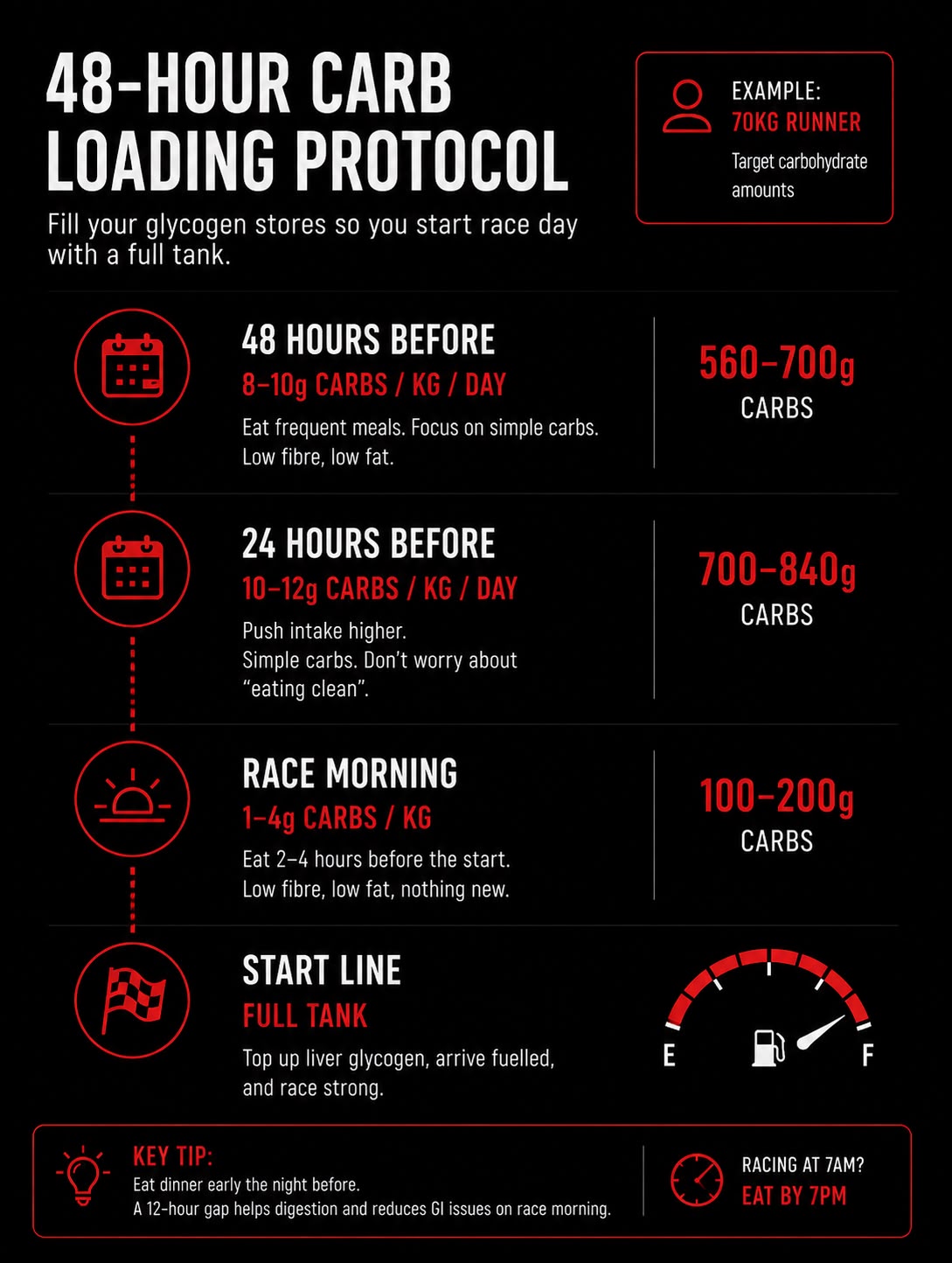
Target ranges for a 70kg runner. Treat these as reference points rather than targets to hit exactly.
Race Morning: The Pre-Race Meal
Your pre-race meal has one job: top up liver glycogen, which depletes overnight, without leaving anything sloshing around in your stomach at the gun.
The guideline is 1-4 grams of carbohydrate per kilogram, eaten 2-4 hours before the start (Jeukendrup, 2014). For a 7-9am start, that means eating at 4-6am. That said, some runners simply can't eat at 5am without feeling ill, and forcing it is worse than working around it. If that's you, eat a smaller breakfast closer to the start and make up the difference with a sports drink or a gel in the final hour. What matters is arriving topped up, not hitting a particular number by 6am.
A 70kg runner might aim for 100-200 grams, and that's a deliberately wide range because tolerance varies enormously. Some people happily put away a full bowl of porridge and toast three hours out. Others manage a banana and a slice of white bread and race brilliantly on it. Options that sit well for most people: porridge (ideally made with water rather than milk) with banana and honey, white toast with jam, a plain bagel with honey, or white rice with a pinch of salt.
The principles are simple. Stick to foods you've tested in training. Keep fibre low. Keep fat low. Avoid dairy if it causes you any issues. Beyond that, the best pre-race breakfast is the one you've eaten before a dozen long runs and never thought twice about.
On caffeine: stick to your usual intake. Race morning is not the time to discover that three espressos make you jittery and desperate for a toilet. If you normally have a coffee, have a coffee. Just be mindful of creamers, milk, and other dairy additions, which are the part most likely to cause problems.
In the 30-60 minutes before the gun you can sip a sports drink or take a small carb top-up, if that's something you've practised. Optional, not essential.
The single most important rule of race morning: nothing new. If you haven't eaten it before a long run, don't eat it before a race. Your gut has no idea it's race day and will not make an exception for you.
During the Race: Fuelling on the Move
This is where races are won, lost, or spent in a hedge.
The basics. For anything longer than 60-90 minutes, you need carbohydrates during the race. The traditional 30-60 grams per hour works well for half marathons and for anyone who hasn't trained their gut for more. For marathon runners, current evidence supports 60-90 grams per hour, using what researchers call "multiple transportable carbohydrates," which is a fancy way of saying a mix of glucose and fructose.
Treat these as ranges to explore rather than quotas to hit. Where you land inside them depends on your pace, your gut, the weather, and how you feel on the day.
Why the mix matters. Your intestine absorbs glucose through one transporter (SGLT1), and that transporter maxes out at roughly 60 grams per hour. Adding fructose, which uses a completely different transporter (GLUT5), opens a second lane on the motorway and pushes total absorption to around 90 grams per hour. This is why modern gels and drinks use a glucose-to-fructose ratio of around 1:0.8 to 2:1. Studies have shown oxidation rates up to 108 grams per hour with dual-source carbs, compared to that hard 60-gram ceiling with glucose alone.
Can you go higher? Should you go higher? These are two different questions, and the second one matters more.
Elite athletes are now targeting 90-120 grams per hour, and research on trail marathon runners found 120g/hour was tolerable and reduced markers of muscle damage. But look at who that applies to. A 2:00 marathoner running 2:50/km is working at a very high percentage of their aerobic capacity and drawing 80-95% of their energy from carbohydrate. They genuinely need that much fuel coming in. A 4:00 marathoner is getting perhaps 50-70% of their energy from carbs and burning through glycogen far more slowly. Pushing 120g/hour in that scenario isn't necessary nor heroic, it's just an expensive way to give yourself stomach cramps.
Match your intake to your effort. Faster and harder means more carbs. Steadier and longer means fewer.
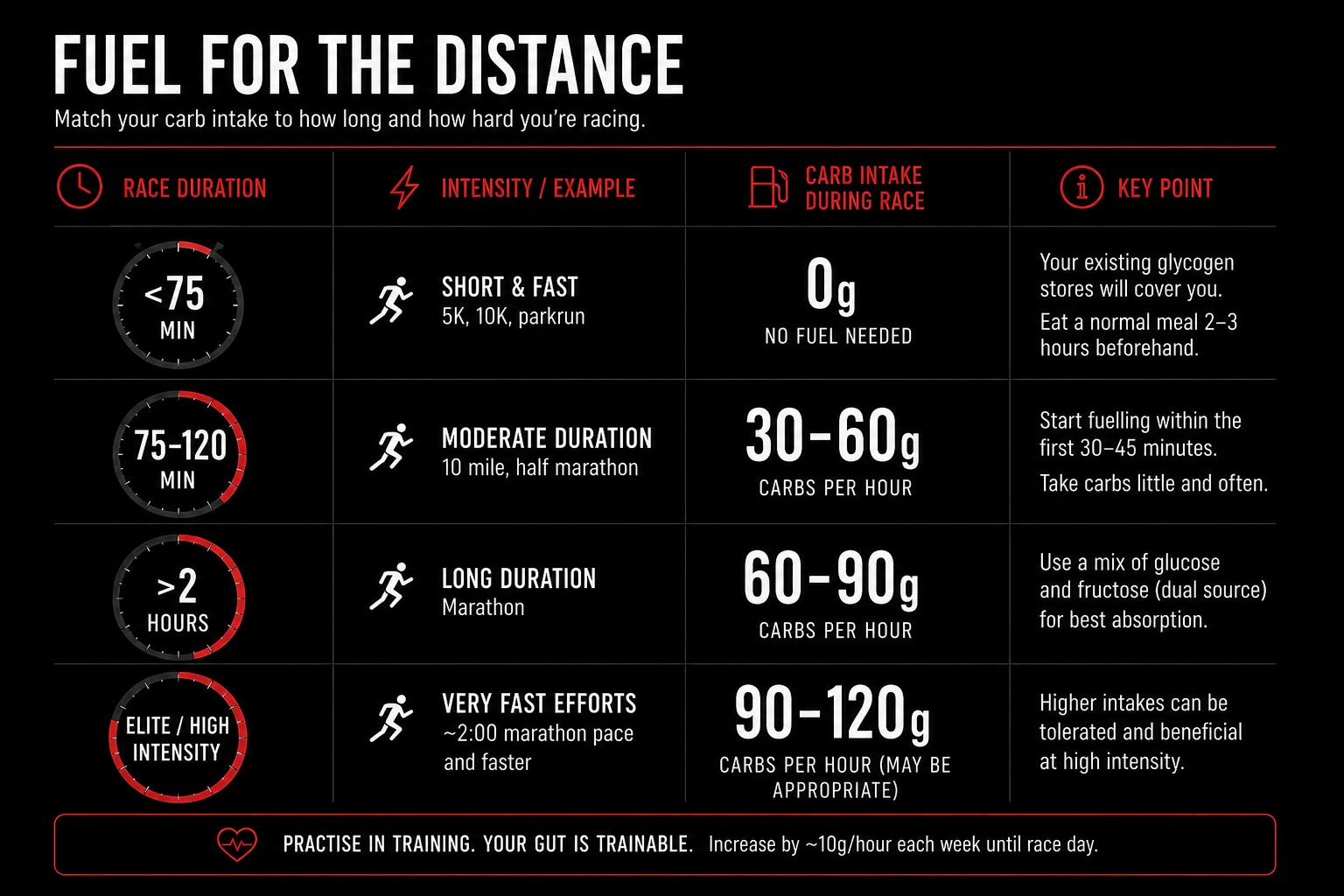
Where you land inside each range depends on your pace, your gut, and the conditions on the day.
Gut training. Your gut is trainable, just like your legs. Two to ten weeks of deliberately practising higher carb intake during long runs increases the density of those intestinal transporter proteins and improves what you can absorb and tolerate at race pace. Start wherever you're comfortable, often 30-40g/hour, and add roughly 10 grams per hour each week. Some runners climb steadily to 90g and feel fine. Others find their ceiling at 50g and race perfectly well there. Finding your own ceiling is the point of the exercise, not reaching someone else's.
Little and often. This is the bit most runners get wrong. You don't need to slam an entire gel in one go, especially if it has a high amount of carbs in it (30g plus). Taking half a gel every 10-15 minutes is far easier on your stomach than a full one every 25, and it keeps your blood glucose steadier. Sip your sports drink rather than gulping it. Your gut can only absorb so much at once, and anything it can't process just sits there, sloshing. That said, some runners genuinely prefer the simplicity of a whole gel on a fixed schedule, and if that's been working for you, carry on. But if you've had stomach trouble in past races, smaller and more frequent is the first thing worth experimenting with.
Heat changes things. In hot conditions your body diverts blood away from the gut and toward the skin for cooling, which makes absorbing carbohydrate meaningfully harder. If you're racing in the heat, expect to tolerate less than you would on a cool day, and plan accordingly. We covered the wider physiology in our pieces on running in the heat and heat acclimation, but the practical version is simple: hot race, dial the carbs back slightly and lean more on liquid fuel.
Timing. Start early, within the first 30-45 minutes. Don't wait until you feel hungry or flat, because by then you're already behind and playing catch-up rarely works. Set a reminder on your watch if that helps, though plenty of runners prefer to fuel by landmark or aid station rather than by beep. Whatever keeps you consistent.
What If I'm Only Doing a 5km?
Then relax. Genuinely.
For anything under about 60-75 minutes, your existing glycogen stores will cover you. There's no need to carb load, no need to fuel during the race, and no need to carry gels for a parkrun. You'd finish before your body absorbed them anyway.
What does matter for shorter races: eat a normal, familiar meal 2-3 hours beforehand, keep it light and low in fibre, and stay reasonably hydrated. A banana and a coffee 90 minutes out is a perfectly good 5km strategy. Some runners find a small carb hit (like a sip of a gel) 10-15 minutes before the start helps with feel and focus, and there's decent evidence for caffeine improving performance in shorter efforts. But the elaborate fuelling protocols in this article are for races where fuel actually becomes the limiting factor.
The rough dividing line: under 75 minutes, don't overthink it. Between 75 minutes and two hours, take on some carbs. Over two hours, follow the full plan.
Hydration: Enough, But Not Too Much
Drink to thirst. That's the headline, supported by Cheuvront and Kenefick (2014) and endorsed by most sports medicine bodies. Your thirst mechanism is a surprisingly good gauge of what you actually need.
For most runners, underdrinking remains the more common problem, particularly in warm conditions. Losing more than 2-3% of your body weight in fluid measurably impairs performance, and plenty of people finish races meaningfully dehydrated. So drink at aid stations, drink when thirsty, and don't be precious about it.
That said, it is possible to overdo it. Exercise-associated hyponatraemia, where blood sodium drops below 135 mmol/L from excessive fluid intake, affects a small but real proportion of marathon finishers. It's most common among slower runners (4+ hours) who drink at every single aid station regardless of thirst, usually plain water without any sodium. The longer you're out there, the more chances you have to overdo it.
The takeaway isn't to be scared of drinking. It's to drink when you're thirsty rather than to a rigid schedule, and to make sure what you're drinking contains sodium.
On sodium. Sweat contains anywhere from 200 to 2,000mg of sodium per litre, and that range is enormous because sweat composition is highly individual. For races over 90 minutes, sodium in your drinks, gels, or capsules helps you retain fluid and absorb it more effectively. If you're a salty sweater (white residue on your kit, stinging eyes), you're at the higher end and should take it seriously. Hot conditions increase both sweat rate and sodium loss, which adds a hidden training load most runners underestimate.
A Sample Marathon Race-Day Nutrition Timeline
Here's race day for a 70kg runner targeting a 3:30-4:00 marathon with an 8:00am start, aiming for 60-70g carbs per hour. Read this as one worked example rather than a schedule to follow. It shows how the pieces fit together for one runner on one day. Yours will look different, and it should.
4:30-5:00am Wake up. 500ml water with electrolytes.
5:00-5:30am Pre-race meal: porridge (80g oats, made with water), banana, tablespoon of honey, pinch of salt, plus white toast with jam. Around 150g carbs. Coffee if that's your normal routine.
6:30-7:00am Sip a sports drink (500ml, ~30g carbs). Final bathroom visit.
7:45am Half a gel with a few sips of water. Line up.
8:00am Start. Nothing needed for the first 20-30 minutes.
From 8:25am onward Half a gel every 10-15 minutes, or a full gel every 25-30 if you prefer, alternating with sports drink at aid stations. Target 60-70g per hour. Drink to thirst throughout.
Around halfway Consider a caffeinated gel (50-100mg caffeine) if you've practised it. Many runners find this useful from 20-25km.
30-35km Keep fuelling if you can. This is where glycogen runs low and where it matters most. Your stomach may well start having opinions around now. Push through mild reluctance, but if you're genuinely nauseous, switch to liquid carbs or ease off rather than forcing a gel down and making things worse.
Finish Start recovery within 30-60 minutes.
Total during the race: approximately 200-250g of carbs, on top of your pre-race meal and carb loading.
Important: this is a template, not gospel. Adjust it to your pace, your products, and your stomach, and rehearse it in your long runs. The dress rehearsal matters as much as the plan.
After the Finish Line
Recovery nutrition matters, and the first 30-60 minutes are when your muscles are most receptive to refuelling. Aim for a mix of carbohydrate and protein, roughly 3:1 if you want a number, alongside fluid and sodium. In practice this matters far less than simply eating something reasonably soon. Chocolate milk, a recovery shake, or a proper meal if your stomach is up for it all work fine.
Then, if you've just run a marathon, go and have the pizza and the beer. You've earned them. The recovery window that actually matters is the following 24-48 hours, and one celebratory meal will not undo months of training. Just don't make it your entire recovery strategy, and be a bit more disciplined after your regular long runs, where the reward-meal habit does add up.
Key Takeaways
Carb loading is simpler than the internet suggests. 48 hours at 8-12g carbs per kilogram per day, combined with your taper, does the job. Treat the lower end as the realistic target and stop when you feel full.
Your pre-race meal should be 1-4g carbs per kilogram, 2-4 hours before the start. Low fibre, low fat, nothing new, normal caffeine.
During the race, aim for 30-60g carbs per hour for a half marathon and 60-90g for a marathon, using a glucose/fructose blend. Take it little and often rather than in large hits.
Match your intake to your intensity. A 2:00 marathoner draws 80-95% of their energy from carbs. A 4:00 marathoner draws 50-70%. Faster means more fuel, not everyone needs more fuel.
Under 75 minutes of racing, a light breakfast before is enough. Save the protocols for when fuel is genuinely the limiting factor.
Drink to thirst rather than to a schedule, and make sure your fluids contain sodium. Underdrinking is the more common error, but overdrinking plain water carries real risk over four hours.
Heat reduces how much carbohydrate you can absorb, because blood flow gets redirected to your skin. In a hot race the GI risk goes up, so experiment with slightly less fuel and more of it as liquids.
Every number here is a starting point, not a rule. Test them in training, notice what your body does with them, and adjust. The best fuelling plan is the one you've personally proven, not the one with the most impressive figures.
Race day nutrition is one of the few variables entirely within your control. You can't control the weather, the course, or how your legs feel at mile 22. But you can arrive with a full tank, fuel consistently, and drink sensibly. Work out what that looks like for you, rehearse it until it's boring, and everything else gets a little easier.
Next up: Recovery Strategies for Marathon Runners, where we cover what the evidence actually says about bouncing back.
Zepho is adaptive coaching for serious runners. It's live and available now on the App Store.