Heat Acclimation for Runners: The Complete Guide to Training Your Body for the Heat
From hot baths to active heat sessions, the complete guide to training your body for summer racing
Colin Norris, ex Professional Triathlete & Endurance Coach
12 MIN
At the 2018 London Marathon, temperatures hit 24.1°C (75.4°F), making it the hottest in the event's 37-year history. The average finishing time was 20 minutes slower than the previous year. Thousands of experienced runners, many with months of structured training behind them, found themselves walking sections they'd planned to race. The fitness was there. The heat preparation, for most, was not.
Here's the thing: you can train your body to handle the heat. It's called heat acclimation, and it's one of the most accessible and evidence-backed performance interventions available to recreational runners. Whether you're preparing for a summer half marathon or just trying to survive your long runs in July without feeling like you've been microwaved, the protocols are surprisingly straightforward.
In our previous piece on running in the heat, we covered what happens inside your body when temperatures rise and how much to adjust. This article picks up where that left off: how to actually prepare your body so the heat becomes a strength, not just something to survive.
What Happens When You Heat Acclimate?
Your body is remarkably good at adapting to heat, if you give it the right stimulus. Here's what's going on under the hood.
The first changes are cardiovascular. Your blood plasma volume expands, which means your blood can carry more oxygen while still routing blood to the skin for cooling. Your heart gets more efficient, maintaining the same output at a lower heart rate. If you're tracking your data, you'll often see this as a noticeable drop in heart rate at the same pace over the course of an acclimation block. It's one of the most satisfying trends you'll ever see on your watch.
Then come the sweating adaptations: you start sweating earlier, sweating more, and distributing sweat more evenly across your skin. Your body is getting better at its primary cooling mechanism. Your sweat also becomes more dilute, so you lose fewer electrolytes per litre of fluid, which has practical implications for managing your training load during hot weather blocks.
Deeper adaptations include reductions in resting core temperature and improved metabolic flexibility. A 2025 study in the Journal of Functional Morphology and Kinesiology found that passive sauna exposure in 12 elite trail runners influenced glucose metabolism, cholesterol, and hemoglobin levels. There's also a meaningful mental component: runners who've trained in the heat develop a psychological resilience to the discomfort, which matters enormously on race day when it's hot and every runner around you is slowing down.
These adaptations share some overlap with altitude training, where the body also adapts through plasma volume changes and improved oxygen transport. The increased blood plasma produced through heat adaptation creates a similar response to altitude training, allowing heat-adapted athletes to move oxygen more easily and perform better at altitude. We'll explore altitude acclimation in a future article, but the key takeaway is that heat training produces real, measurable physiological changes, not just toughness.
Can You Get Heat Acclimation Benefits Without Running in the Heat?
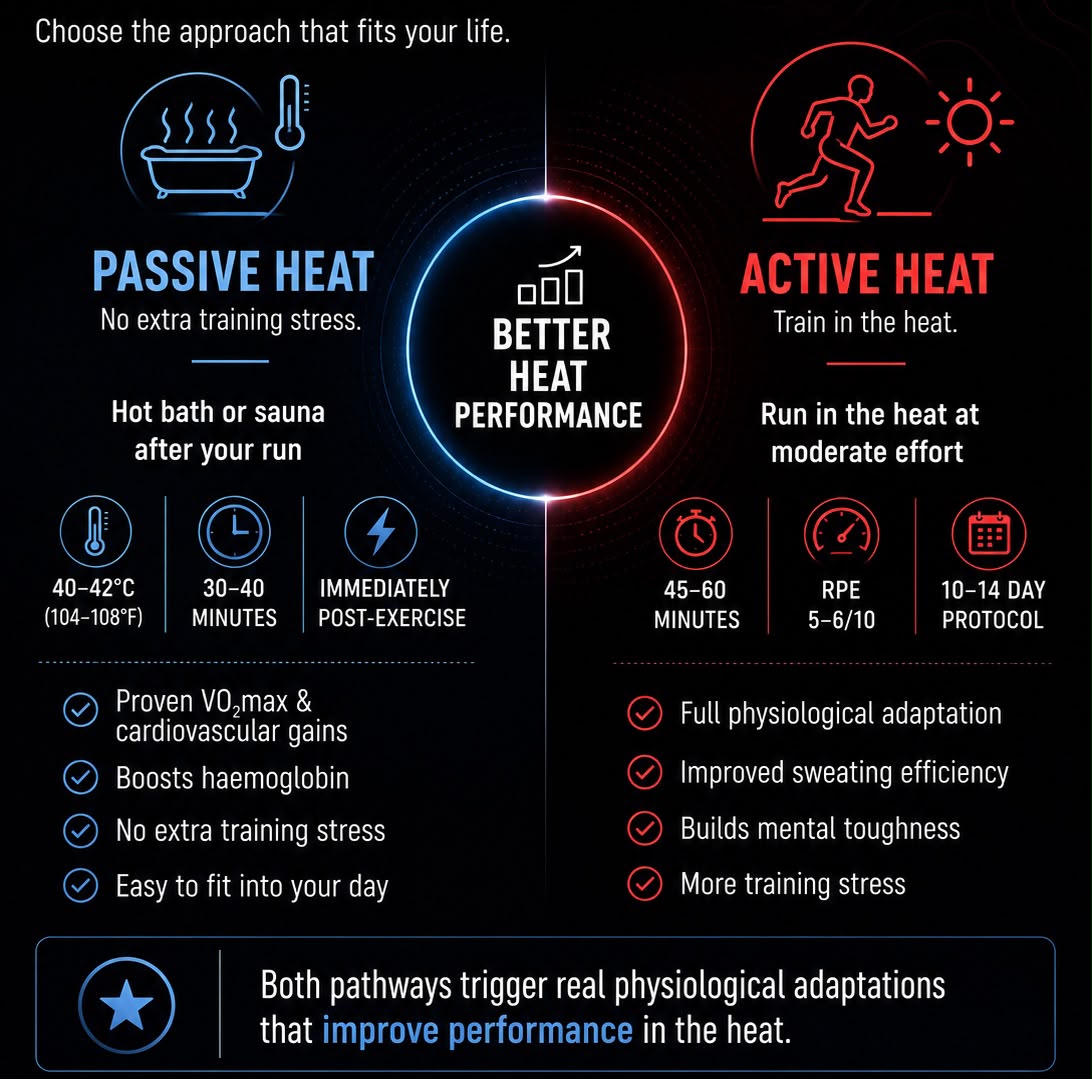
This is where things get genuinely exciting. Passive heat acclimation, using hot baths or saunas after your normal training sessions, can produce many of the same cardiovascular adaptations as deliberate heat training. If you live somewhere where summer means 16°C and drizzle, or you're in a heavy training block and can't afford to add more stress, this is your best option. And it's a very good one.
Post-exercise hot water immersion
The protocol is beautifully simple: sit in a hot bath at 40-42°C (104-108°F) for 30-40 minutes immediately after your normal training session. The key word is "immediately." When your core temperature is already elevated from exercise, the hot water extends the thermal stimulus without requiring any additional training stress.
A 2025 study by Jenkins et al. in the Journal of Physiology demonstrated this clearly. Ten well-trained runners completed five weeks of post-exercise hot water immersion using a within-subject crossover design (the same runners acted as their own control group). The result: a 2.7 mL/kg/min improvement in VO2max, driven by increased hemoglobin mass and improved oxygen transport. The researchers framed this as a legitimate alternative to altitude training for VO2max gains.
The practical appeal is obvious. You don't need to change your training. You don't need access to a climate chamber. You run your normal session, come home, and sit in a hot bath. It's the kind of intervention that makes you wonder why more people aren't doing it.
Sauna protocols
Traditional (Finnish) sauna at 80-90°C (176-194°F) for 20-30 minutes post-exercise offers a similar thermal stimulus, and the 2025 JFMK study on elite trail runners showed improvements in metabolic markers including glucose, cholesterol, HDL, and hemoglobin. Infrared sauna is less studied but likely produces similar, possibly attenuated, effects.
The honest assessment: sauna is probably a slightly better option than the bath, but it comes with real-world limitations. If you don't have access to saunas at home, the 30-40 minute round trip to a gym or spa is time that, for most time-crunched runners, would be better spent in a hot bath at home. The best protocol is the one you'll actually do consistently, and for the majority of recreational runners, the hot bath is the sustainable choice.
When passive protocols make the most sense
Passive heat acclimation is particularly valuable when you can't access hot environments (during UK winters, for example, though we wouldn't mind escaping to the Canary Islands either), during high training load blocks where adding active heat sessions would tip the balance between productive stress and overreaching, as a complement to active protocols (morning run in the heat plus an evening bath or sauna), and for off-season VO2max maintenance.
How Does Active Heat Training Work?
Active heat acclimation means deliberately training in hot conditions, and it remains the most direct route to comprehensive adaptation. The approach is simple in principle: run in the heat at a moderate aerobic intensity you can sustain for the full duration.
For the vast majority of recreational runners, intensity during heat sessions should be guided by RPE (rate of perceived effort) rather than heart rate or pace. This matters because heat inflates your heart rate through cardiac drift, making heart rate zones unreliable, and your pace will naturally drop in warm conditions. An RPE of 5-6 out of 10 during heat sessions keeps you in the productive zone without tipping into overreaching. If you use a wearable core temperature monitor like the CORE sensor, a target of around 38.5°C (101.3°F) provides an additional data point, but RPE should remain your primary guide.
A practical short-term protocol looks like this: 5-7 sessions of 45-60 minutes at moderate intensity, completed on consecutive or near-consecutive days. This produces meaningful cardiovascular adaptations within a week, though these early gains are also the most fragile and often feel the most stressful. A medium-term protocol of 10-14 days produces more durable adaptations across all systems: cardiovascular, sweating, metabolic, and perceptual.
There's a critical consideration here that's easy to overlook: heat training is an additional stressor. For runners training 3-6 hours per week, this added load can be significant. Traditional metrics like TSS and CTL won't fully capture it because they don't account for the cellular load of elevated body temperatures. This is where intelligent training load management becomes essential. Aside from slowing down on your aerobic runs, you may need to reduce your overall weekly training volume. It's also important to keep your easy days out of the heat entirely, and protect your intense sessions by running early in the day or indoors. The goal is to add heat stress without sacrificing the fundamental training adaptations you're building toward.
How Long Does Heat Acclimation Take, and How Quickly Do You Lose It?
Understanding the timeline is essential for planning your passive and active heat strategies around a target race.
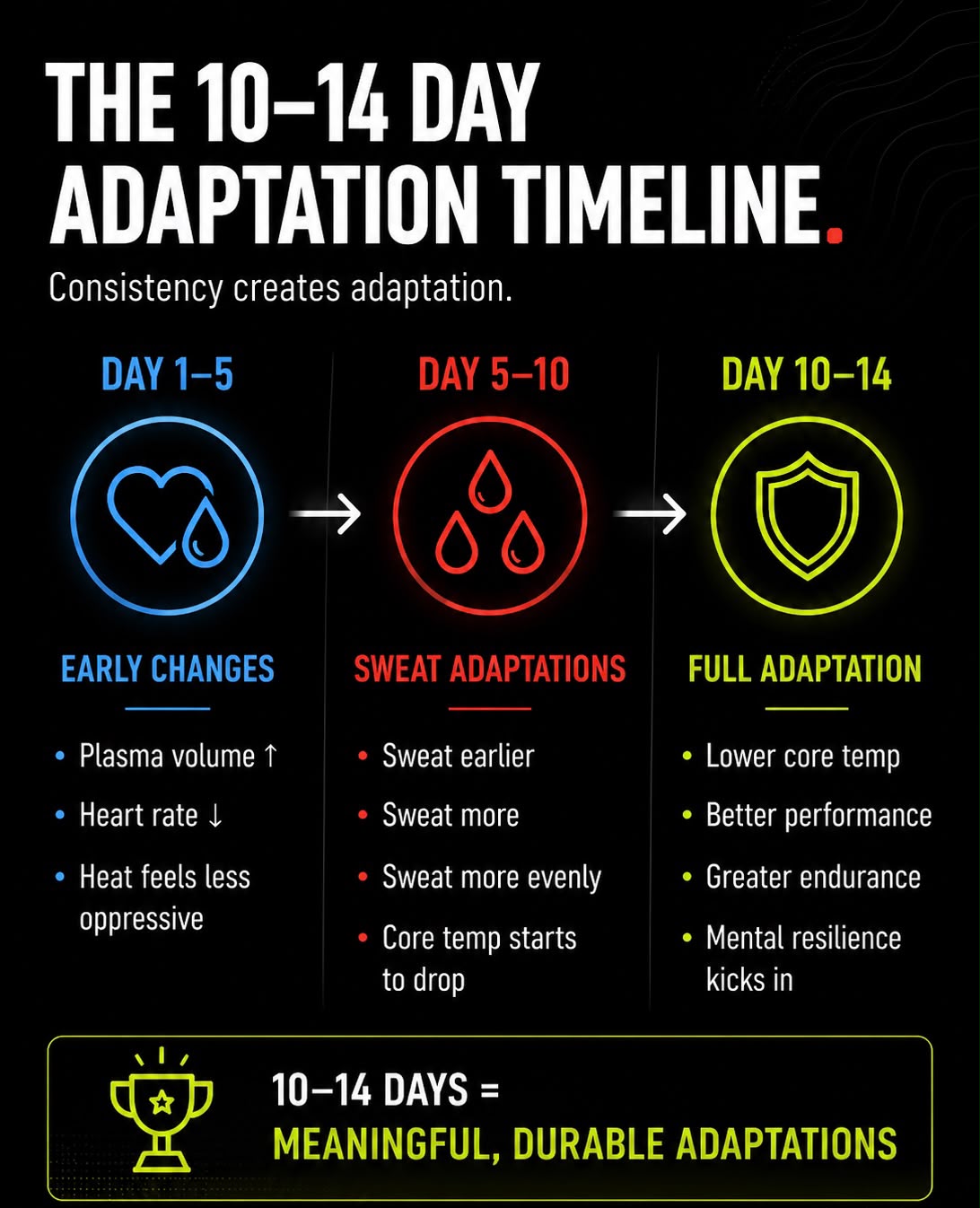
Adaptation develops in stages. In the first five days, you'll see plasma volume expansion, initial heart rate reductions, and early perceptual improvements (the heat simply feels less oppressive). These are the "quick wins," but they're also the most fragile adaptations and often feel the most stressful. Between days 5 and 10, sweating adaptations emerge: sweat rate increases, sweat distribution improves, and core temperature during exercise begins to drop. By days 10-14, you reach full acclimation, with cardiovascular, sweating, metabolic, and perceptual adaptations all established.
Decay is the other side of the equation. Research by Daanen et al. (2018) found that adaptations are lost at roughly 2.5% per day without heat exposure. The practical rule of thumb: for every two days without heat exposure, you lose about one day of acclimation. After two weeks without exposure, you can expect to have lost approximately 35% of heart rate adaptations, around 30% of sweat rate adaptations, and roughly 6% of core temperature adaptations. This sharp decline is an important consideration when it comes to using heat protocols strategically around your races, something we cover below.
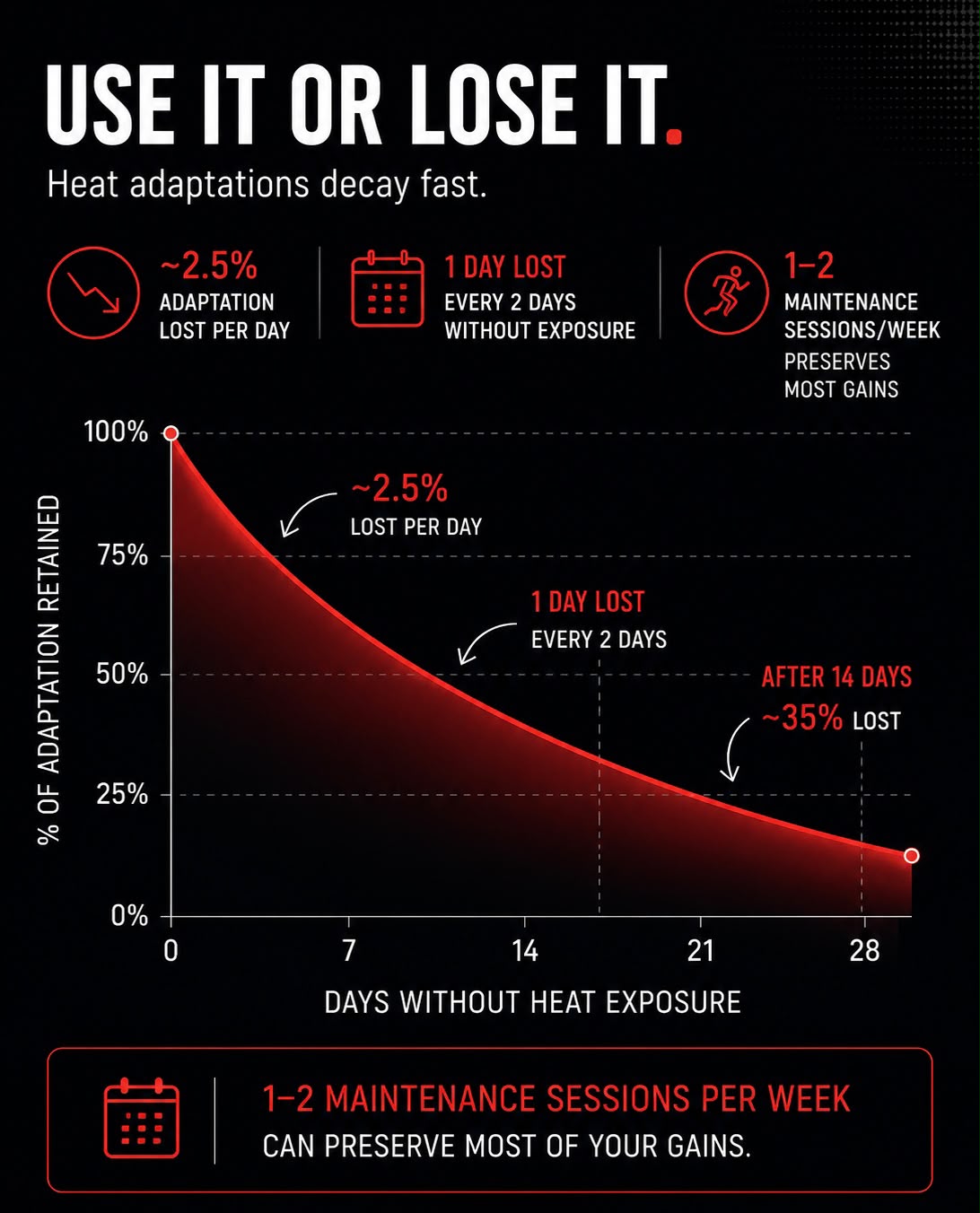
The encouraging news is that your body "remembers." Re-acclimation after a period of decay is substantially faster than initial acclimation, and even one or two top-up exposures per week can slow or partially reverse decay. A runner who acclimated three weeks before a race can do 2-3 top-up sessions in race week to restore meaningful adaptations.
Short-term protocols (fewer than 7 days) decay rapidly, often within two weeks. Medium-term protocols (10-14 days) show greater durability, with meaningful adaptations retained for 3-4 weeks.
What Should Female Runners Know About Heat Acclimation?
The research on heat acclimation has historically underrepresented women, which means much of the standard guidance is based primarily on male physiology. This is changing, but it's important to be aware of the differences.
During the luteal phase of the menstrual cycle (post-ovulation), resting core temperature is elevated by approximately 0.3-0.5°C due to progesterone. This means you're effectively starting from a higher thermal baseline, reducing the margin before heat-related performance degradation begins. The practical implication: the same session may feel harder in the luteal phase, and this should be accounted for in RPE expectations.
Available evidence suggests women achieve similar magnitudes of adaptation to men but may require longer protocols. Mee et al. (2015) found that 9 days, rather than the 4 suggested for males, of heat acclimation improved self-paced endurance performance in females, suggesting the medium protocol of 10-14 days may be more appropriate. A 2026 study presented at the APS Summit examined 23 endurance-trained female runners using a combined protocol (active training plus hot tub sessions) over three weeks and found improved heat tolerance and promising durability signals, though the results weren't yet statistically significant.
Hormonal contraception can also influence thermoregulation by altering the hormonal environment that controls your body's thermostat. If you use hormonal contraception and are planning a heat acclimation block, it's worth discussing with your coach or sports medicine professional.
How Do You Know If Heat Acclimation Is Working?
You don't need expensive equipment to track this. The most reliable markers are ones you can observe during your normal training.
Your resting heart rate should trend downward over 7-14 days as plasma volume expands. Running the same easy route in similar conditions, your heart rate at a matched pace should drop by 5-15 bpm over the protocol. Your HRV trends will likely show initial suppression in the first 3-5 days (heat is a stressor, and this is expected), followed by gradual recovery that signals adaptation. Don't panic at suppressed HRV early in the block. It's a sign the stimulus is working, not that something's gone wrong.
RPE at matched effort is subjective but meaningful: the same session should feel progressively easier. Sweat onset and volume will change too: sweating earlier and more is a positive sign. And perhaps the simplest indicator is how you actually feel. If your confidence in the heat is growing and the discomfort is becoming manageable rather than overwhelming, your body is adapting.
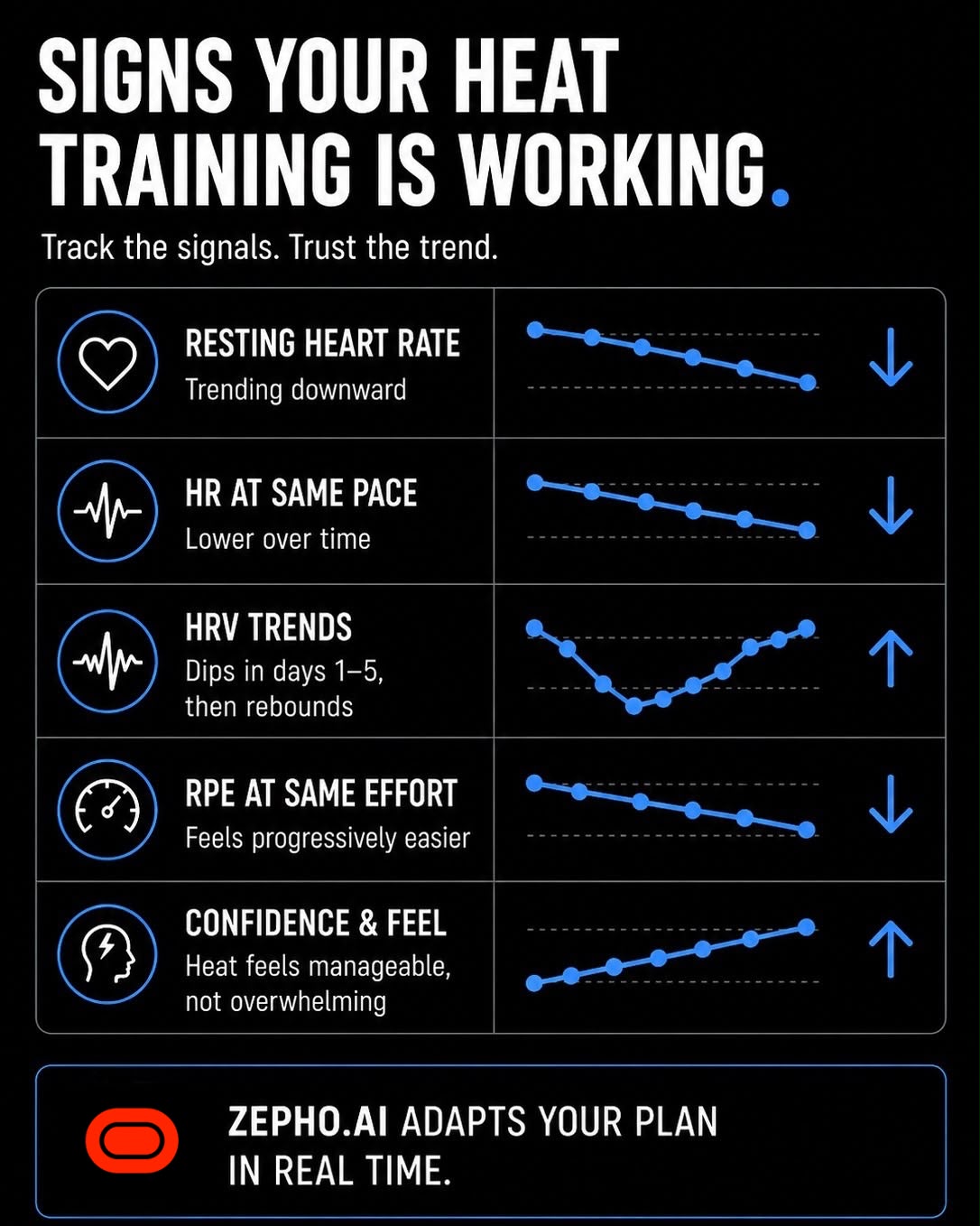
An AI-driven coaching platform can detect these patterns automatically through your HR and HRV data, adjusting your training plan as your heat tolerance builds rather than waiting for you to manually interpret the trends.
How to Build Heat Acclimation into Your Training
The right approach depends on your timeline and circumstances.
If you have 3-4 weeks before a hot-weather race: Begin with a 10-14 day active or passive protocol. In weeks one and two, aim for 4-5 heat sessions alongside passive top-ups (post-run bath or sauna). In week three, reduce to 2-3 maintenance sessions. In race week, 1-2 light heat exposures are sufficient, with nothing in the last 48 hours.
If you're building general summer fitness with no specific race: Maintain an ongoing passive protocol of 2-3 sauna or bath sessions per week alongside normal training. Add occasional deliberate heat runs at the hottest part of the day 1-2 times per week. Keep your easy days and more intense days out of the heat to protect your recovery and intensity.
If you have less than two weeks: Prioritise passive protocols (daily post-exercise baths at 40°C for 30 minutes). Add 2-3 active heat sessions at moderate intensity. Accept partial adaptation. Even 5-7 days of consistent heat exposure produces meaningful cardiovascular gains.
Regardless of your approach, be aware of the common mistakes: going too hard during heat sessions (which turns acclimation into overreaching), neglecting hydration (you're sweating more by design, so revisit the hydration guidance from our running in the heat piece), stopping acclimation too early before a race and losing adaptations, and ignoring recovery. Heat acclimation is training stress. It belongs in your load management plan, not on top of it.
Key Takeaways
Passive heat acclimation (hot baths at 40-42°C for 30-40 minutes post-exercise) can produce meaningful VO2max and cardiovascular adaptations without changing your training. A 2025 study showed a +2.7 mL/kg/min VO2max improvement from five weeks of post-exercise hot water immersion.
Active heat training at moderate RPE (5-6/10) for 45-60 minutes per session over 10-14 days produces comprehensive acclimation. Consider reducing your overall training volume during a heat block, and keep easy days out of the heat entirely.
Heat acclimation decays at roughly 2.5% per day without exposure, but your body retains a "memory" that makes re-acclimation faster. Maintenance sessions of 1-2 exposures per week can preserve most adaptations.
Female runners may need longer protocols (10-14 days minimum) and should account for menstrual cycle phase effects and use of hormonal contraception on core temperature and RPE.
The best heat acclimation protocol is the one you'll do consistently. For most runners, a post-exercise hot bath is more sustainable and accessible than a sauna, and both are more practical than relocating your training to a hotter climate (tempting as the Canary Islands might be in January).
Monitor adaptation through resting heart rate, HR at matched pace, HRV trends, and subjective feel. Initial HRV suppression in the first 3-5 days is expected and not a reason to stop.
Heat acclimation is one of the few training interventions where the science is clear, the protocols are accessible, and the gains are genuinely meaningful. You don't need a climate chamber or a sports science lab. You need a plan, some consistency, and a willingness to be uncomfortable for a few weeks. Your body will do the rest.
Next up: Race Day Nutrition for Marathon Runners, where we will cover the evidence-based fuelling strategies that keep you running strong when it matters most.
Zepho is adaptive coaching for serious runners. It's live and available now on the App Store.